


In early 1974, a journalist named Sam Keen went to a hospital in British Columbia, so he could interview a man who was dying. This man’s name was Ernest Becker. He was a cultural anthropologist and 49 years old.
He was dying of colon cancer, and he didn’t have much time left. Becker’s book, The Denial of Death, was about to win the Pulitzer Prize. But he’d be dead before they handed that prize to him.
Sam Keen assumed the interview would be cancelled because of Becker’s physical health, but it wasn’t. Ernest Becker wanted to push on, and the first thing Becker said in this interview is what made me want to write this newsletter.
He said his experience of dying was “a test of everything I’ve written about death. How does one die? And I’ve got a chance of showing how one dies.”
Becker was a man who spent his whole career arguing that human beings will do almost anything they can to avoid confronting their own mortality.
But in that moment, as death was right there in the room with Becker, he did not shy away, he faced it head-on. Becker treated his own dying as a final exam of his life’s work.
I find this very interesting and brave and Becker’s big idea shares much alignment with the Aliveness philosophy.
The quote Becker is best known for is this….
“The idea of death, the fear of it, haunts the human animal like nothing else. It is a mainspring of human activity."
What he’s saying is that underneath all of our human ambition and busyness and chasing of status, there’s a deep fear we spend our whole lives trying to avoid. I wrote an article about this a year ago.
This fear is the simple fact that we’re going to die.
And unfortunately, because we are not equipped or educated to talk about, or deal with death, we bury the subject. We then throw ourselves into what Becker called ‘immortality projects’. The career, the company… the name on the building… the legacy…. Anything that makes a human feel permanent instead of temporary and small.
Becker said we unconsciously chase this immortality in two different ways. The first is the obvious one… You try to become a kind of hero. For example, you build the empire or make the fortune. You get your name on the building or create something big enough that the world won’t forget you. You basically outrun death by being too important to disappear.
The second way is more subtle, and it’s the one most of us actually fall into. You attach yourself to something bigger than you that feels like it will last forever. Your country. Your religion. Your football club. The company. A cause. You borrow its permanence, and some of that “forever” rubs off on you.
Becker thought both were the same move underneath. Both are a way of feeling like you matter, in a universe that’s going to carry on perfectly well without you.
Does this need for ‘immortality’ resonate with you?
I fell into this trap myself, for most of my adult years, trying to create things that would outlast me. On reflection, the fear I was carrying on an unconscious level was part of what ultimately led me to suffer panic attacks and a total change in life direction as I began to explore mortality.
The fact is, we don’t face death - the only certainty in life - so we never quite face life either.
We often resign ourselves to continuing in roles that no longer align with the people we have become on the inside.
And because we ignore death > we take life for granted > we assume we have more time than we do > we postpone the things that matter most in our lives > and we find ourselves drifting > this leads to regret and a life half-lived.
Becker identified this pattern loop in his book… and it’s reassuring to have some serious scholarship to back up the theories within the Aliveness philosophy
But Becker did not have an easy career. He was frequently pushed out of universities, and almost always for the same reason. He wouldn’t compromise on his views on life and death. He’s reported to have lost one job for backing a colleague in a fight over academic freedom. He resigned from another over how students were being treated. He went from Syracuse to Berkeley to San Francisco, and ended up at a small university in Canada. Never quite fitting in anywhere, never willing to buy himself some safety by keeping his mouth shut. Ultimately, he chose his own truth over his own comfort, again and again.
And when it came to dying, he is reported not to have found it the nightmare that many people expect.
He is quoted to say, “I consider it to be a peaceful event”. He told Keen, about it becoming a great sense of relief. The man who understood the fear of death better than almost anyone met his own death with something close to peace.
So what can we take from Ernest Becker today?
The fear of death is real, and it’s steering far more of your life (and our societies) than you’d like to admit, or are aware of.
The restlessness, the postponing, the ignoring of instinct… Becker would say, look underneath all of it, and most of the time you’ll find the fear of death with its hands on the wheel. Fear-based decision-making is everywhere, and it is highly destructive.
But Becker’s act of dying shows another angle. When you turn and face death head-on, the fear of it fades. What’s on the far side isn’t terror; it’s clarity, and a strange sort of calm, and the chance to spend whatever time you’ve got left on what actually matters to you, while you still can.
Becker had 16 months between his diagnosis and his death. He spent much of that time showing us how to die, and in doing so, how to live.
My Next Workshop
We don’t need to wait for a diagnosis to start living our life fully. And if you’ve read this far, you probably already know the fear I’m talking about, and where it’s holding you back.
On Saturday 14 November, I’m teaching the Aliveness Practice at the Jung Center of Houston. Two hours, online. Come and get some real clarity on what matters.
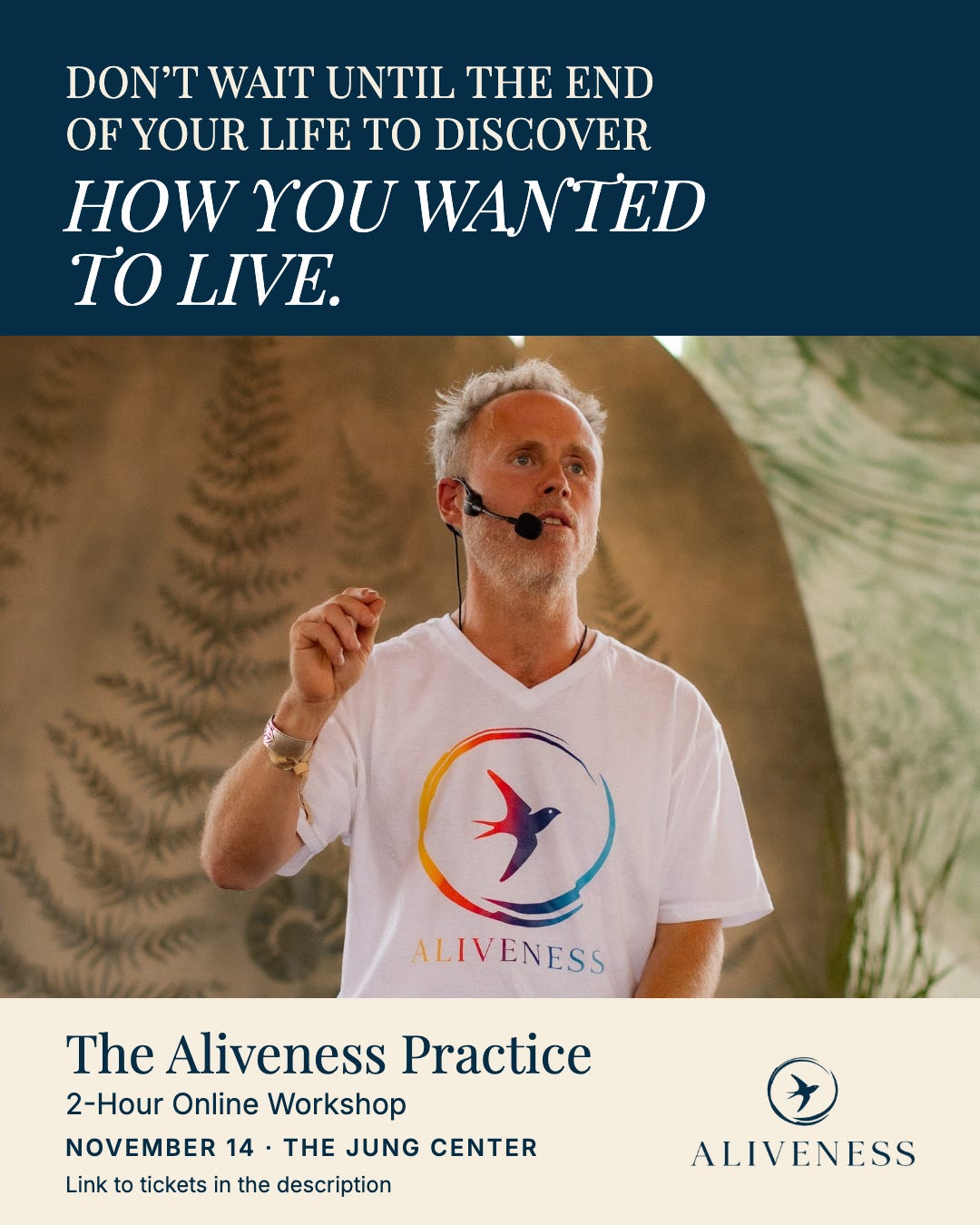
Please join me live on Saturday November 14th
10am–12pm CT / 4pm-6pm UK / $40
“A colossal reframing of my existence. What I got from the workshop is that I can stop making and remaking the decision to commit my life to art, and just honour that decision. To give myself to it with love, glee and a sense of adventure.”(Jeremy)
“Looking at life through the awareness that our time is finite did not feel dark or confronting. Quite the opposite. Looking back from the perspective of an older version of myself brought a remarkable simplicity to questions that can otherwise become incredibly complicated. What matters? What am I postponing? What would I regret not becoming?” (Monica)
Premium Aliveness Content
Assets for free and paid subscribers, including the audio recording of my last workshop, can be found in TOOLS. Please have a look.
This week’s question.
Be really honest with yourself for a second. What are you building to outrun the fear of your own ending? And is that really how you want to spend your time?
Make the most of the time you have.
Live happy,
Hoppy

Tools / Essays / Events / Instagram / Manifesto / About
If this article landed with you, please share it with one person who needs it.
I am a former CEO & filmmaker, as well as a trained Soul Midwife and Druidic Bard. Aliveness emerged from my own near death experiences, sitting with the dying, and the wisdom of the Stoics, Buddhists and great thinkers on mortality. My dream is that Aliveness will become as impactful as Mindfulness: a daily practice helping people live more bravely, leave fewer regrets and create a more present and generous world.


